
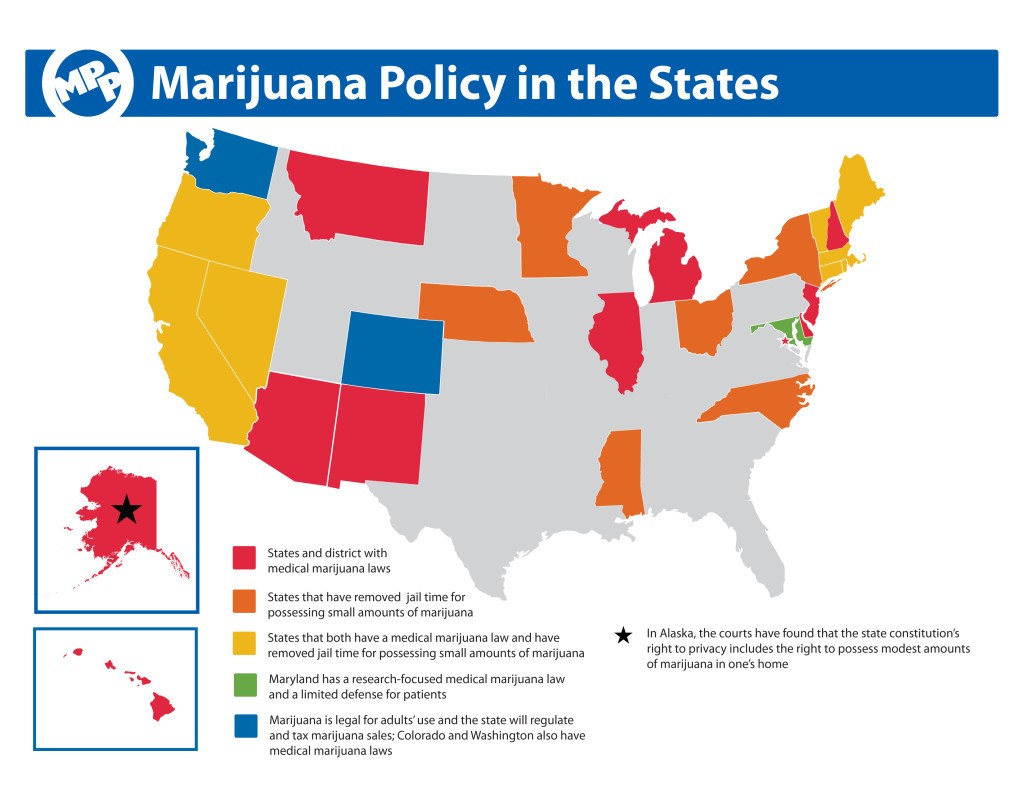
Alabama, Florida, Georgia, Indiana, Iowa, Kentucky, Minnesota, Mississippi, Missouri, North Carolina, Pennsylvania, South Carolina, Tennessee, Utah, Virginia and Wisconsin have all recently gone to pot. And that’s just the beginning….


-
The Ultimate Election Update
We stand behind our outrageous tagline, The World’s Best Resource for Marijuana News, Entertainment and Culture. That said, when a Pulitzer-Prize-Winning newspaper that broke the Watergate and Pentagon Paper stories want to try and “scoop” us and break down the details, we let ’em!Thanks to reporters Denise Lu, Ted Mellnik and Niraj Chokshi for this update.
-
I CAN SEE LEGALIZATION FROM HERE: ALASKA TO VOTE IN NOVEMBER
With the general election five months away, more Outside cash is making its way into the Alaska campaign to legalize marijuana.
The Marijuana Policy Project injected $140,000 into the Campaign to Regulate Marijuana Like Alcohol in Alaska at the end of May, according to filings with the Alaska Public Offices Commission. It marks the second largest donation the campaign has received this election season and pushes the contribution total for the campaign just over the half-million dollar mark.
Western Alaska leaders fret over marijuana legalization in rural communities
Supporters issue challenge to opposition in fight to legalize marijuana in Alaska
In comparison, the group opposing the measure, Big Marijuana. Big Mistake. Vote No on 2, has raised a mere $31,000 since organizing in April. Most of that money came from a single donation from the Chenega Corp., an Alaska Native village corporation based in Anchorage, which gave $25,000 to the campaign last month.
At stake is Ballot Measure 2, an initiative that would regulate and tax marijuana like alcohol in Alaska. If approved, the initiative would regulate the production, sale, and use of marijuana to adults 21 years of age and older and tax its commercial sale. Alaska would become the third state to legalize marijuana, behind Washington and Colorado. The initiative’s language is largely based on Colorado’s law.
Proponents say the measure is long in coming and that the “prohibition” on marijuana isn’t working. Opponents argue that it’s too much, too soon, and that Alaska doesn’t need to be the testing ground for marijuana legalization. Polls conducted earlier in the year put support for the initiative at around 50 percent.
The $140,000 doesn’t mark the biggest donation from the Marijuana Policy Project, a national group that works to advocate for marijuana legalization across the U.S. In March, the organization contributed $210,000 in cash to the Alaska campaign. It also sent one staff member, Chris Rempert, to serve as campaign director.
Pro-legalization campaign spokesman Taylor Bickford said the donation will be used to “continue educating Alaskans” about the benefits of legalizing marijuana here. He said it was not intended to serve as a response to the large donation from Chenega.
“We have our own strategy and our own plan that we will be executing between now and November,” he said.
Deborah Williams, spokeswoman with the Big Marijuana. Big Mistake. Vote No on 2 campaign, was not surprised to hear about the large donation Thursday, nor was she concerned, she said.
“We always anticipated we would be grossly outspent,” Williams said.
The anti-legalization campaign has focused on maintaining a grassroots presence, working more to start conversations and participate in forums that “get the truth of this initiative out” Williams said.
Williams noted that other Alaska political battles have proved that Alaskans don’t take well to Outside groups pushing agendas in Alaska.
“No matter how much money the Marijuana Policy Project and other Lower 48 entities put into this battle, they can’t eliminate those truths,” Williams said.
Bickford rejected the idea that the Marijuana Policy Project was pushing any sort of agenda. He said the group has been working to reform marijuana policy in Alaska for 20 years, and in that time has built meaningful connections in the state.
“Alaskans are going to focus on the issues. They’re not going to focus on distractions and fundraising,” he said.
What the campaign will look like from here remains to be seen. Bickford noted that with the U.S. Senate race dominating traditional advertising media right now, most campaigns are in the process of figuring out “how to deal with that.”
“All the campaigns are struggling with the limited air space due to the influx of money in the senate race,” Bickford said. “We plan on running a comprehensive campaign that connects with voters in various ways.”
(THANKS TO REPORTER SUZANNA CALDWELL and the Alaska Dispatch for this report.)
-

GrassIsNotGreener Is a Downer, Man
At HigherGround, our responsibility is to show you all sides of the debate in and around the legalization of marijuana (aka Prohibition), and let you decide where you stand. The following is an ad from a coalition who opposed the recent editorial decision at the New Times Editorial Board which endorsed the legalization movement. Have a read, and we’ll be following up with additional thoughts and perspectives.(From the Washington Post)
A coalition of groups is running a full-page advertisement in the New York Times this weekend, advocating against the maturing movement to legalize marijuana.The ad comes in response to a New York Times editorial series launched last weekend arguing for an end to marijuana prohibition. In it, the newspaper’s editorial board advocated for an end to the federal ban on the drug. The ad, pictured below, features a businessman with the pasted-on head of a hippie, a visual metaphor for what the groups warn is the disconnected perception and reality when it comes to legalization.
“The legalization of marijuana means ushering in an entirely new group of corporations whose primary source of revenue is a highly habit-forming product,” the ad reads. “Sounds a lot like another industry we just put in its place. Many facts are being ignored by this and other news organizations. Go to GrasslsNotGreener.com to see why so many major medical associations oppose marijuana legalization.”
The website, which contains resources about the dangers of marijuana, is affiliated with Project SAM, which stands for Smart Approaches to Marijuana. The nonprofit was co-founded by former congressman and former head of the Democratic Congressional Campaign Committee Patrick Kennedy and former Obama administration drug policy adviser professor Kevin Sabet. It advocates against legalization, but in favor of dropping mandatory minimum sentences and removing criminal penalties while expunging records for low-level users of the drug, and pushes for better access to treatment, education and prevention. The group contends that legalization risks the creation of a predatory industry
“In the marijuana business, the values of the flower children have been quickly replaced by the values of Wall St. power brokers,” Sabet said in a statement. “We’re on the brink of creating the next Big Tobacco. We feel like this is an important message most Americans have not considered.”
The implementation of legalization by Colorado officials–some of them at least initially opposed to it–has been described as a success, though it’s too early to assess the public health impact of the law itself. In Washington, the only other state to also legalize pot, the drug went on sale this month. Legalization is on the November ballot in Oregon and Alaska.
The coalition behind the new website includes:
The American Society of Addiction Medicine, a group that boasts more than 3,000 addiction physician and professional members
The National Association of Drug Court Professionals, a nonprofit whose members include judges, attorneys and clinical specialists
National Families in Action, a group dedicated to getting state laws passed to prevent marketing of drugs and drug use to children.
Parents Opposed to Pot.(Thanks to Niraj Chokshi for this story. Niraj also reports for GovBeat, The Post’s state and local policy blog.)
http://www.washingtonpost.com/blogs/govbeat/wp/2014/08/02/coalition-runs-full-page-new-york-times-ad-to-dispute-pro-marijuana-editorial/