
(AP) – Oklahoma pro-marijuana advocates are pushing for a second signature drive to get the issue a statewide vote, this time for full legalization of cannabis, similar to Colorado and Washington.
Supporters of marijuana legalization filed an initiative petition on Friday with the Oklahoma secretary of state’s office. They will have three months to gather more than 155,000 signatures from registered voters to get the proposal on a statewide ballot.
It is the second marijuana-related initiative petition underway in Oklahoma. Supporters of medicinal marijuana already have launched a petition drive that would legalize the drug only for medical purposes.
Several politicians from both sides of the political aisle have announced their support for pro-marijuana initiatives, including both of the Republicans running against Gov. Mary Fallin in the June 24 GOP primary election.


-
BET YA DIDN’T KNOW IT WASN’T LEGAL IN JAMAICA, MON!
Jamaica’s government on Thursday announced a major rethinking of its marijuana laws, including plans to partially decriminalize small amounts of pot and to allow possession for religious, scientific and medical purposes.
Justice Minister Mark Golding said the Cabinet is backing a proposal to make possession of no more than 2 ounces (57 grams) of marijuana, or “ganja” as it’s known locally, a petty offense that would result in a fine but not a criminal arrest.
“I wish to stress that the proposed changes to the law are not intended to promote or give a stamp of approval to the use of ganja for recreational purposes,” Golding said. “The objective is to provide a more enlightened approach to dealing with possession of small quantities.”
Golding also announced that marijuana will be decriminalized for religious purposes — a major victory for Jamaica’s homegrown Rastafari spiritual movement. Many Rastafarians smoke marijuana as a sacrament which they say brings them closer to the divine but they have always faced the possibility of prosecution for doing so.
Government plans call for decriminalization for medicinal and scientific purposes as Jamaica hopes to cash in on the burgeoning cannabis industry. “It is not only wrong but also foolhardy to continue with a law that makes it illegal to possess ganja and its derivatives for medicinal purposes,” Golding said.
Legislation will also be drafted to provide a path for people to get criminal records expunged if they have been convicted under the current law for smoking small amounts of marijuana.
Debate has raged for decades around loosening marijuana laws in Jamaica, an island that is nearly as famous for its weed as it is for its scenic beaches and unique culture. The drug has been pervasive but outlawed for a century on the island where about 300 young men receive criminal records each week for possessing a little marijuana.
Previous efforts in Jamaica to decriminalize small amounts of marijuana have been scuttled because officials feared they would violate international treaties and bring sanctions from Washington.
But as the pot decriminalization movement gains unprecedented traction across the globe, particularly in U.S. states, there’s been a growing push to lift restrictions on a cash-strapped island where political leaders have been emboldened by changes in the U.S.
“I think it highly unlikely this will get a negative reaction from the Obama administration,” said Ethan Nadelmann, director of the nonprofit Drug Policy Alliance, a pro-legalization group based in New York.
Ruling party lawmaker Raymond Pryce, who introduced a motion to relax drug laws in the House last year, said he’s confident that the administration of Prime Minister Portia Simpson-Miller “will continue to take all appropriate and necessary steps to completely achieve a legitimate ganja sector fully reflective of the religious, cultural and medicinal opportunities which can now be pursued.”
Golding stressed that the current law prohibiting pot remains in effect until legislation to amend that law has been authorized by lawmakers. With Simpson-Miller’s party having a 2-to-1 majority in Parliament and many opposition legislators supporting relaxing the drug laws, the measures are almost certain to be authorized.
(THANKS TO REPORTER DAVID MCFADDEN AND ABC NEWS FOR THIS REPORT)
-
Oregon Legalization on the November Ballot
Second time may be a charm for cannabis is Oregon. The initiative has gathered enough signatures for another vote on legalizing marijuana.
If it passes this November, Oregon will become the latest in a string of U.S. states to liberalize marijuana laws, either for recreational or medical use. Alaska will also vote this year, then California in 2015, and the tide will have turned….
READ MORE at Reuters
-
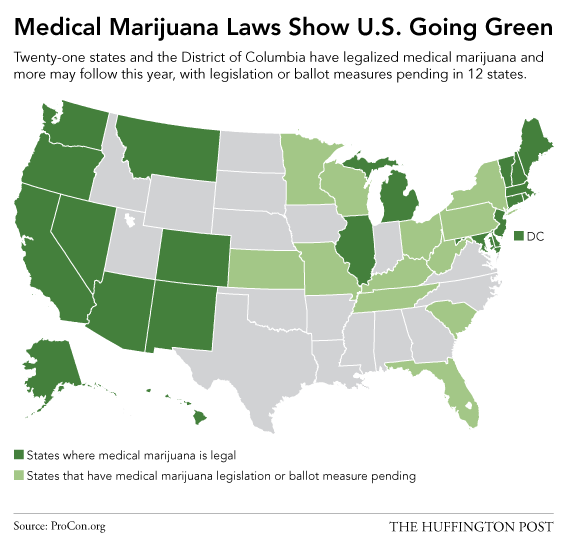
Here’s the Weed Law In Every Damn Legal State
Alaska
Law: Measure 2 (52.15%)
Year Passed: 2014
Date Implemented: February 24th, 2015
Age Requirement: 21
Administrative Agency: Marijuana Control Board
Tax Structure: $50 per ounce on all marijuana sold by wholesale cultivation facilities, additional local taxes expected
Recreational Outlets: No, expected to open Spring 2016
Possession Limit: 1 oz, and all marijuana from a grow, at the location of that grow
Home Cultivation: 6 plants, with only 3 in flowering stage at a time
Transport: 1 oz.Colorado
Law: Amendment 64 (55.3%)
Year Passed: 2012
Date Implemented: January 1st, 2014
Age Requirement: 21
Administrative Agency: Department of Revenue, Marijuana Enforcement Division (MED)
Tax Structure: 15% on grower, 10% special sales tax, 2.9% standard sales tax, additional local taxes may apply
Recreational Retail Outlets: Yes
Possession Limit: 1 oz, non-residents of Colorado 0.25 oz
Home Cultivation: 6 plants, with only 3 in flowering stage at a time
Transport: 1 oz, open container law appliesOregon
Law: Measure 91 (56.1%)
Year Passed: 2014
Date Implemented: July 1st, 2015
Age Requirement: 21
Administrative Agency: Oregon Liquor Control Commission
Tax Structure: 17% sales tax
Recreational Retail Outlets: MMJ dispensaries to begin selling recreational October 2015 via Senate Bill 460. Possession Limit: 8 oz at home, 1 oz outside, 1 lb solid edibles, 72 oz liquid, 1 oz extract (concentrates)
Home Cultivation: 4 plants
Transport: 1 oz within state lines, Non-flowering plantsWashington
Law: Initiative 502 (55.7%)
Year Passed: 2012
Date Implemented: July 8th, 2014
Age Requirement: 21
Administrative Agency: Washington State Liquor Control Board
Tax Structure: 25% at all stages, grower, processer, retailer and customer, plus normal sales taxes
Recreational Retail Outlets: Yes
Possession Limit: 1 oz marijuana, 16 oz of marijuana-infused products in edible form, and 72 oz of marijuana products in liquid form
Home Cultivation: No
Transport: 1 ozWashington D.C. (formally District of Columbia)
Law: Initiative 71 (64.8%)
Year Passed: 2014
Date Implemented: February 26, 2015
Age Requirement: 21
Administrative Agency: None
Tax Structure: None, retail & sale is still illegal
Recreational Retail Outlets: No
Possession Limit: 2 oz
Home Cultivation: 6 plants, with only 3 in flowering stage at a time
Transport: 2 oz
Alaska
Law: Measure 2 (52.15%)
Year Passed: 2014
Date Implemented: February 24th, 2015
Age Requirement: 21
Administrative Agency: Marijuana Control Board
Tax Structure: $50 per ounce on all marijuana sold by wholesale cultivation facilities, additional local taxes expected
Recreational Outlets: No, expected to open Spring 2016
Possession Limit: 1 oz, and all marijuana from a grow, at the location of that grow
Home Cultivation: 6 plants, with only 3 in flowering stage at a time
Transport: 1 oz.Colorado
Law: Amendment 64 (55.3%)
Year Passed: 2012
Date Implemented: January 1st, 2014
Age Requirement: 21
Administrative Agency: Department of Revenue, Marijuana Enforcement Division (MED)
Tax Structure: 15% on grower, 10% special sales tax, 2.9% standard sales tax, additional local taxes may apply
Recreational Retail Outlets: Yes
Possession Limit: 1 oz, non-residents of Colorado 0.25 oz
Home Cultivation: 6 plants, with only 3 in flowering stage at a time
Transport: 1 oz, open container law appliesOregon
Law: Measure 91 (56.1%)
Year Passed: 2014
Date Implemented: July 1st, 2015
Age Requirement: 21
Administrative Agency: Oregon Liquor Control Commission
Tax Structure: 17% sales tax
Recreational Retail Outlets: No; Still illegal to buy or sell. Outlets expected 2016 – MMJ dispensaries may begin selling recreational October 2015 if Senate Bill 460 is signed into law.
Possession Limit: 8 oz at home, 1 oz outside, 1 lb solid edibles, 72 oz liquid, 1 oz extract (concentrates)
Home Cultivation: 4 plants
Transport: 1 oz within state lines, Non-flowering plantsWashington
Law: Initiative 502 (55.7%)
Year Passed: 2012
Date Implemented: July 8th, 2014
Age Requirement: 21
Administrative Agency: Washington State Liquor Control Board
Tax Structure: 25% at all stages, grower, processer, retailer and customer, plus normal sales taxes
Recreational Retail Outlets: Yes
Possession Limit: 1 oz marijuana, 16 oz of marijuana-infused products in edible form, and 72 oz of marijuana products in liquid form
Home Cultivation: No
Transport: 1 ozWashington D.C. (formally District of Columbia)
Law: Initiative 71 (64.8%)
Year Passed: 2014
Date Implemented: February 26, 2015
Age Requirement: 21
Administrative Agency: None
Tax Structure: None, retail & sale is still illegal
Recreational Retail Outlets: No
Possession Limit: 2 oz
Home Cultivation: 6 plants, with only 3 in flowering stage at a time
Transport: 2 ozThanks to Smoker’s Guide for their in-depth research.

Comments are closed.