It’s hard to even keep up with the number of major newspapers FINALLY coming around to support the legalization of marijuana. Here’s a brief list. Don’t blink…or you’ll miss (yet) another….
The Oregonian Endorsement
The Seattle Times Endorsement
The New York Times Endorsement – NYTIMES continues to blow minds…
About the Author
Zoe is a Portland-based blogger who covers Entertainment and Lifestyle for Higher Ground. And no, she does not watch Portlandia.You Might also like
-
New York Times Endorses Legalization
By THE EDITORIAL BOARD
It took 13 years for the United States to come to its senses and end Prohibition, 13 years in which people kept drinking, otherwise law-abiding citizens became criminals and crime syndicates arose and flourished. It has been more than 40 years since Congress passed the current ban on marijuana, inflicting great harm on society just to prohibit a substance far less dangerous than alcohol.
The federal government should repeal the ban on marijuana.
We reached that conclusion after a great deal of discussion among the members of The Times’s Editorial Board, inspired by a rapidly growing movement among the states to reform marijuana laws.
There are no perfect answers to people’s legitimate concerns about marijuana use. But neither are there such answers about tobacco or alcohol, and we believe that on every level — health effects, the impact on society and law-and-order issues — the balance falls squarely on the side of national legalization. That will put decisions on whether to allow recreational or medicinal production and use where it belongs — at the state level.
We considered whether it would be best for Washington to hold back while the states continued experimenting with legalizing medicinal uses of marijuana, reducing penalties, or even simply legalizing all use. Nearly three-quarters of the states have done one of these.
But that would leave their citizens vulnerable to the whims of whoever happens to be in the White House and chooses to enforce or not enforce the federal law.
The social costs of the marijuana laws are vast. There were 658,000 arrests for marijuana possession in 2012, according to F.B.I. figures, compared with 256,000 for cocaine, heroin and their derivatives. Even worse, the result is racist, falling disproportionately on young black men, ruining their lives and creating new generations of career criminals.
There is honest debate among scientists about the health effects of marijuana, but we believe that the evidence is overwhelming that addiction and dependence are relatively minor problems, especially compared with alcohol and tobacco. Moderate use of marijuana does not appear to pose a risk for otherwise healthy adults. Claims that marijuana is a gateway to more dangerous drugs are as fanciful as the “Reefer Madness” images of murder, rape and suicide.
There are legitimate concerns about marijuana on the development of adolescent brains. For that reason, we advocate the prohibition of sales to people under 21.
Creating systems for regulating manufacture, sale and marketing will be complex. But those problems are solvable, and would have long been dealt with had we as a nation not clung to the decision to make marijuana production and use a federal crime.
In coming days, we will publish articles by members of the Editorial Board and supplementary material that will examine these questions. We invite readers to offer their ideas, and we will report back on their responses, pro and con.
We recognize that this Congress is as unlikely to take action on marijuana as it has been on other big issues. But it is long past time to repeal this version of Prohibition.
http://www.nytimes.com/interactive/2014/07/27/opinion/sunday/high-time-marijuana-legalization.html?_r=3&smid=tw-share
-
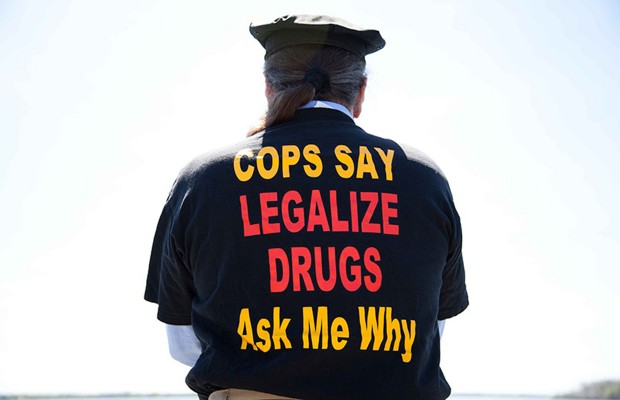
Even Cops Say It’s Time to Legalize Drugs
When thousands of police veterans agree it’s time to end the War on Drugs and legalize marijuana, you know it’s time. Our interview with Law Enforcement Against Prohibition (LEAP) staff Neill Franklin (Exec. Dir.) and Diane Goldstein (Sec.).
-

BET YA DIDN’T KNOW IT WASN’T LEGAL IN JAMAICA, MON!
Jamaica’s government on Thursday announced a major rethinking of its marijuana laws, including plans to partially decriminalize small amounts of pot and to allow possession for religious, scientific and medical purposes.
Justice Minister Mark Golding said the Cabinet is backing a proposal to make possession of no more than 2 ounces (57 grams) of marijuana, or “ganja” as it’s known locally, a petty offense that would result in a fine but not a criminal arrest.
“I wish to stress that the proposed changes to the law are not intended to promote or give a stamp of approval to the use of ganja for recreational purposes,” Golding said. “The objective is to provide a more enlightened approach to dealing with possession of small quantities.”
Golding also announced that marijuana will be decriminalized for religious purposes — a major victory for Jamaica’s homegrown Rastafari spiritual movement. Many Rastafarians smoke marijuana as a sacrament which they say brings them closer to the divine but they have always faced the possibility of prosecution for doing so.
Government plans call for decriminalization for medicinal and scientific purposes as Jamaica hopes to cash in on the burgeoning cannabis industry. “It is not only wrong but also foolhardy to continue with a law that makes it illegal to possess ganja and its derivatives for medicinal purposes,” Golding said.
Legislation will also be drafted to provide a path for people to get criminal records expunged if they have been convicted under the current law for smoking small amounts of marijuana.
Debate has raged for decades around loosening marijuana laws in Jamaica, an island that is nearly as famous for its weed as it is for its scenic beaches and unique culture. The drug has been pervasive but outlawed for a century on the island where about 300 young men receive criminal records each week for possessing a little marijuana.
Previous efforts in Jamaica to decriminalize small amounts of marijuana have been scuttled because officials feared they would violate international treaties and bring sanctions from Washington.
But as the pot decriminalization movement gains unprecedented traction across the globe, particularly in U.S. states, there’s been a growing push to lift restrictions on a cash-strapped island where political leaders have been emboldened by changes in the U.S.
“I think it highly unlikely this will get a negative reaction from the Obama administration,” said Ethan Nadelmann, director of the nonprofit Drug Policy Alliance, a pro-legalization group based in New York.
Ruling party lawmaker Raymond Pryce, who introduced a motion to relax drug laws in the House last year, said he’s confident that the administration of Prime Minister Portia Simpson-Miller “will continue to take all appropriate and necessary steps to completely achieve a legitimate ganja sector fully reflective of the religious, cultural and medicinal opportunities which can now be pursued.”
Golding stressed that the current law prohibiting pot remains in effect until legislation to amend that law has been authorized by lawmakers. With Simpson-Miller’s party having a 2-to-1 majority in Parliament and many opposition legislators supporting relaxing the drug laws, the measures are almost certain to be authorized.
(THANKS TO REPORTER DAVID MCFADDEN AND ABC NEWS FOR THIS REPORT)

Comments are closed.